Workshops Page

We will have a whole range of hands-on workshops for our Mt Shasta Water unConference  on both Friday and Sunday.  Here is a taste – more coming soon.


Water for Wildlife: Wetlands & Restoring Living Landscapes

Hosted by Nikolas Bertulis


Friday: Guzzler planning session
Sunday: Hands-on guzzler installation


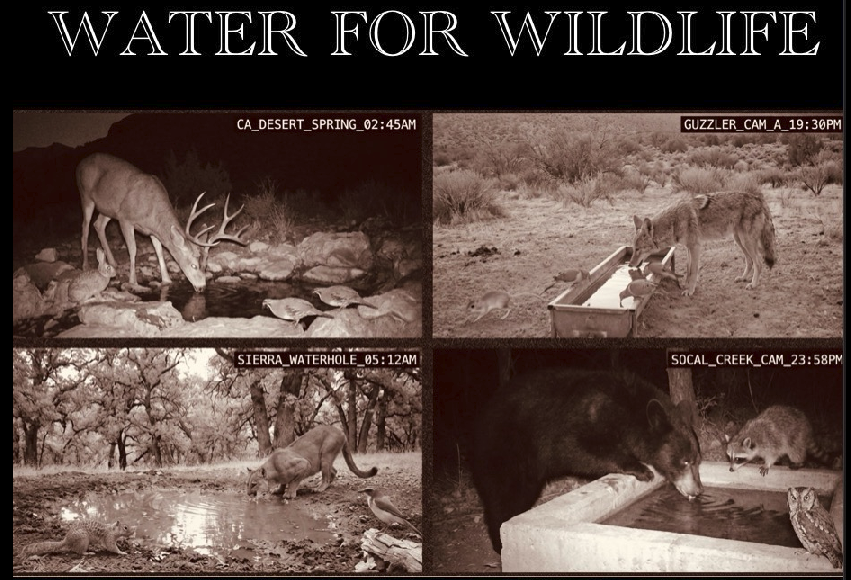
Water is one of the most limiting resources for wildlife, especially during California’s increasingly long, hot, and dry seasons. In this hands-on workshop, participants will explore how thoughtfully designed wildlife water systems, including guzzlers and small-scale wetlands, can restore natural water cycles, reconnect fragmented wildlife corridors, and provide reliable water sources and habitat for birds, mammals, reptiles, amphibians, pollinators, and countless other species. (Click read more …)

We’ll examine the ecology of water in the landscape, the history and conservation role of guzzlers in the American West, and practical techniques for designing, siting, constructing, and maintaining water features that support biodiversity and climate resilience. Whether you’re stewarding a backyard, farm, park, or larger wildland, you’ll leave with the knowledge, skills, and inspiration to create life-sustaining water systems that help revive dry landscapes and restore the living systems that support wildlife.

Process Based Erosion Mitigation and Restoration Techniques

with Charles Upton

Friday 1-5 & Sunday 13th 9-4

Friday: 
Sunday: 


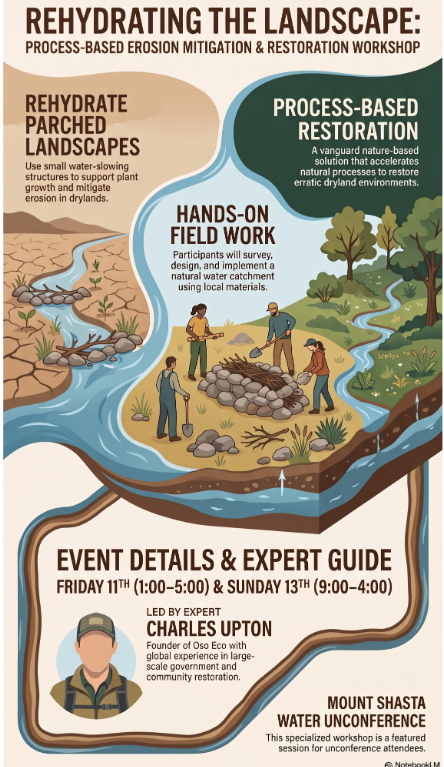
In drylands where precipitation is erratic, with long dry periods and intermittent flooding, there are natural processes which we can enhance and accelerate by implementing small water slowing structures to support plant growth and mitigate erosion. 


This workshop offers an opportunity to learn from Charles Upton, whose years of experience designing and implementing projects across the globe has placed him at the forefront of vanguard naturebased solutions. Charles, Founder of Oso Eco has worked on large scale government restoration projects, ranch, forested, and community projects to create process based restoration solutions to rehydrate parched landscapes at scale.


We will be surveying, designing, and implementing a small natural water catchment utilizing local material collected from the site.

Shasta unConference Social Fabric Workshops by Frank Sanborn

Social Fabric Workshops

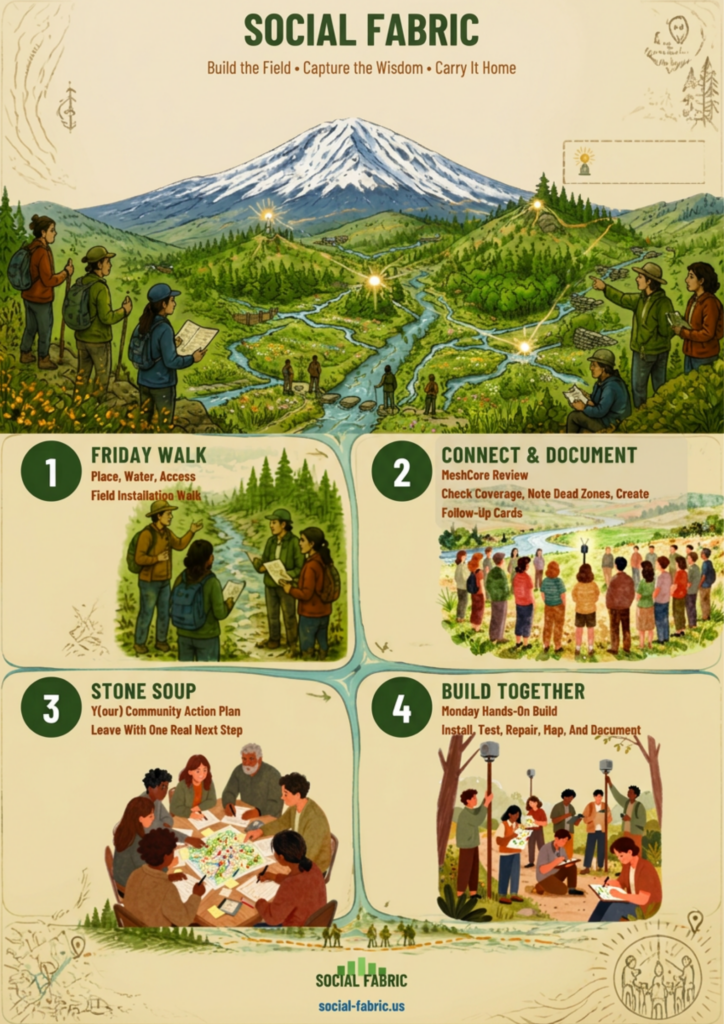
Build the Field • Capture the Wisdom • Carry It Home

1) Place, Water, Access & MeshCore Field Installation 

Friday • Approximately 5 hours (includes review)


Begin with a guided field walk across Hotlum to orient to the land, observe water movement, understand camp access and safety, and install the first phase of Hotlum’s MeshCore field communication network. Along the way, participants will help carry, place, test, and document field nodes while capturing notes, photos, questions, needs, offers, and work ideas.


Following the field walk, we’ll review the initial network, test signal coverage, identify dead zones, make adjustments or repairs as needed, and create follow-up work cards to guide the rest of the weekend and future improvements.


Together, these sessions lay the groundwork for the weekend’s Social Fabric activities, scavenger hunts, field documentation, and Monday hands-on build projects.


(To read about 2 more Social Fabric Workshops – Click Read More …)

2) Y(our) Community Action Plan 

60 to 90 minutes – Sunday

Before leaving Hotlum, participants will be invited to create a simple community action plan. Your plan might be for your household, neighbors, block, garden, school, project, watershed, town, or bioregion. The goal is not to solve everything. The goal is to leave with one real next step.


3) Hands On Build Day 

Optional Monday – Full Day

For people staying after the main gathering, Monday will be a practical build and implementation day.


We will use what was learned during the Friday field walk, Saturday unconference sessions, and Sunday action planning to continue hands-on work at Hotlum.


Possible work includes improving the first MeshCore field network, testing signal coverage, documenting node locations, refining maps, creating follow-up work cards, and preparing the next phase of Hotlum’s field infrastructure.


This is best for people who want to help build, test, document, repair, carry, map, or organize. No single skill set is required.
DIY Water Tending Workshop with Jonathan Kabat

Radical Micro Autonomous Water Works, DIY Tending

With Jonathan Kabat


Friday September 11th : 

Sunday September 13th: 

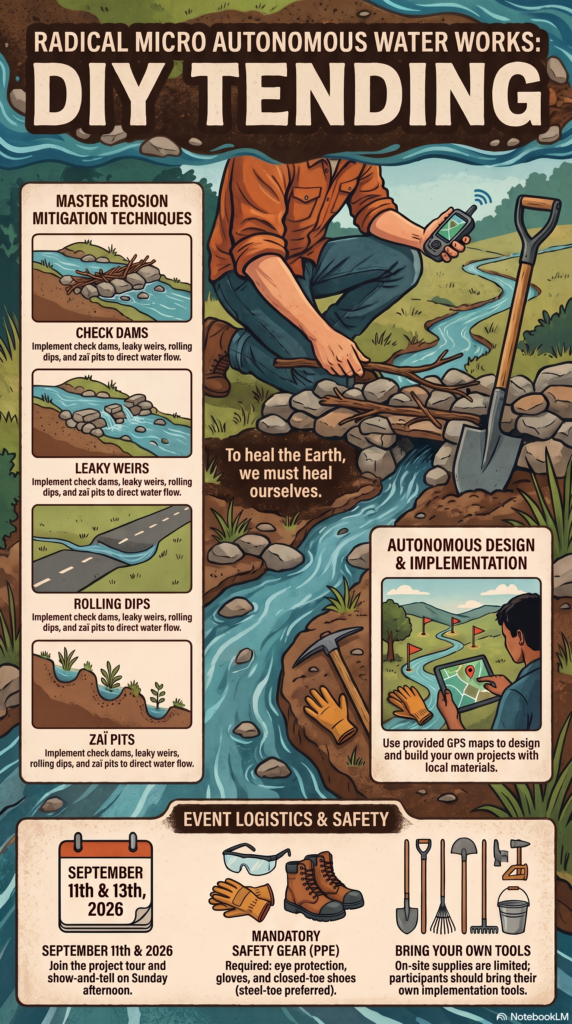
DIY: play with check dams, leaky weirs, rolling dips, and zaï pits. If you feel like being on your own, or just with friends while playing with locally found materials for erosion mitigation techniques to slow and direct Water, this option is open to all participants. A map with suggested locations via GPS will be provided to go out, design, and implement your own projects. Bring your own tools as limited tools are available. *personal protective equipment required, eye protection, gloves, closed toe shoes, (steel toe preferred) Recommended; sunscreen, hat or hard hat, long pants, long sleeves, etc.

Some light guidance will be offered by Jonathan if requested. 

Afterwards a show-and-tell tour of all projects will take place on Sunday.